Sunday, January 27, 2013

Music from the Far North

Music from the Far North
The Living Tradition series
produced by Deben Bhattacharya
ARGO, ZRG 533, Made in England, 1967
They're not quite the true academic field recording records, but much more authentic than the Souvenir from... records tourists used to gather. They're field recordings that are sold commercially. They're an important part of my record collection which is becoming more and more like a stamp collection that doesn't have a topic but holds stamps from all over the world. A collection that's more about diversity than about depth. Records like the one above were owned by people that had a serious interest in some geographical entity, not quite an academic interest but certainly well beyond a tourist's interest in the music of a region. They're records of traditional music, typically played not by the areas biggest stars, but not by the remote and isolated rural population either. The musicians are the in-between musicians, semi-professional, well regarded locally, that would perform in regional cultural festivals. Music from the Far North features traditional music out of Finland and from Sweden. It features the solemn Finnish music on the kantele, and some wild fiddling gatherings from Sweden. There's enough excitement in the music on this record to last a midsummer night but I chose to share here today the two Lappish joiks that are featured at the end of the record. They're not the most interesting joiks I've ever heard, they're not the best tracks on the record, but they're joiks. There aren't that many joik recordings in the world. Joiks are the age old musical singing traditions of the Sami people of Northern Scandinavia. The singing sounds a lot like the chanting of Native Americans. The Sami are remote descendents of the Chukchi people, a handful of whom are believed to have crossed the Bering Sea and are the common ancestors of all American Indians.
The singer of the joiks featured here is Karin Stenberg. She was recorded by Deben Bhattacharya in or before 1967 in Arvidsjaur, Sweden . The first example is a joik about reindeer and the second about mountains. 

p.s. I've never been to Sweden but I have a Volvo. I learned yesterday that if you buy a new Volvo, directly from the factory, they'll fly you over, put you up, and ship the car back for you. Now my Volvo is getting pretty old...

Sunday, January 20, 2013

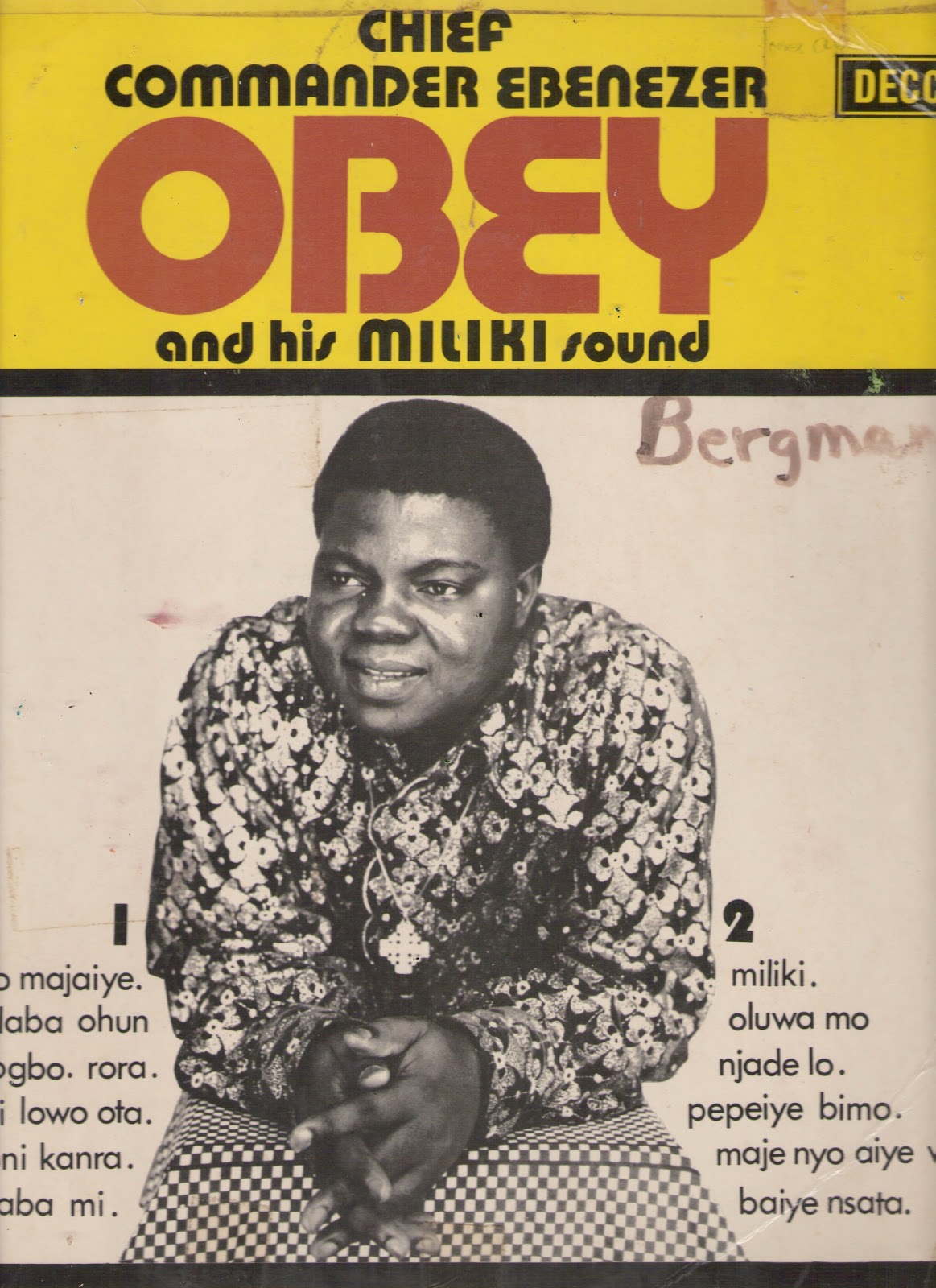
Obey

Chief Commander Ebenezer 
Obey and His Miliki Sound
Decca, WAPS 78
Made in England, 1973
Here's then the second entry concerning Nigerian records found in Florida thrift stores. As promised last week I'll share a song from an album by Chief Commander Ebenezer Obey. The song is Alowo Majaiye, it's the opening track on the album. As with Anyinla Owomura's last week, I only estimated the break between the first two songs as all tracks are woven together medley style. At that point I faded it out, hoping not to cut off anything from the track in question. Really, both side one and side two are just two continues songs that happen to have multiple titles. Kinda like an opera, except that it doesn't sound anything like an opera. It's all about Obey's guitar breaks. The guitar playing throughout this record is magnificent.

Sunday, January 13, 2013

African Records

Ayinla Omowura and His Apala Group, Vol. 8
Procuced by Taoreed Adedigba
Nemi (LP) 0110, EMI, printed in Nigeria
There's gotta be a few notes written in the margins of the above statement because "a whole history of music" turns out to be a very subjective term. The statement holds the people of a city or region in very high esteem when the truth is that especially those people that are represented in the collection of thrift stores are not as expansive and discriminate more than one would hope. Africa is arguably the continent with the most interesting (and on average highest quality) of commercial LPs. Yet records from this continent arrive in thrift stores few and far in between. Occasionally you will find one produced in the West for the Western market (either by Africa's biggest selling stars, like Miriam Makeba, or else compilations of traditional music, both of field recordings and of commercial intent) but hardly ever records plucked from the streets, popular by locals but unknown beyond. The last time I found some of the latter was about five years ago, when I got two Nigerian records in a thrift store in Saint Augustine, Florida. One is by Ayinla Omowura, the other by Chief Commander Ebenezer Obey. Obey is fairly well known in the West but of Omowura I had never heard. Both records belonged to a certain Bergmann. As always when I find multiple records that once belonged to the same person, I am curious about the circumstances. Bergmann got his (or hers) in the US I think. I don't think Bergman bought the records in Nigeria because the Obey one has an import sticker on it from an African market in Brooklyn. The Obey record was pre-owned when Bergmann got it. That's all the clues I have to the Bergmann puzzle. The two records are remarkably similar in production and content. Both records are recorded in medley style, apparently produced for dancing. The songs that are listed as being played are not separated by any noticeable clue (the sound clip below is faded out somewhere in the second song of side A of the Omowura record). It feels like they could be playing forever. In fact Omowura's record is Volume 8, and I wouldn't be surprised if all eight records were recorded in a single or maybe two recording sessions. The opening seconds of both records are spectacular instrumental introductions by (I assume) the respective instruments of the bandleaders: Obey's guitar and the talking drum of Omowura. From an objective point of view these opening seconds are probably all you need to know about, the rest only becomes interesting when you engage in it (like dancing). Next week I'll discuss Obey's (my favorite of the two) some more. The songs you can listen to below are the opening minutes of the medley on side A; Akigbo wo awon and part of Chief Adeniyi Idowu. The word "Yoruba" printed on the label of the vinyl probably refers to the language used in the lyrics. I estimate the recording to be from the early 1970s.

Sunday, January 6, 2013

Country Records

Sammi Smith – New Winds, All Quadrants
Produced by Ray Baker
Elektra Records, 6E-137, New York, 1978
There's a reason why I don't collect country records. I don't like them. If I did, I would have had an enormous collection because on my numerous visits to thrift stores as I always see ones I'd never seen before. That's not to say that I don't have any country records, I actually have quite a few, but I really don't add to these much any more. And that I don't like them is of course a too broad generalization. There are plenty great country records out there that I really like. I love David Allan Coe, Dolly Parton, Kinky Friedman, Hank Williams (Sr.), to name just a few. What I don't like about country records most is the political conservatism that oozes off these records, and the pathos. Well I don't mind pathos, but in the wrong ignorant hands it all ends up being pathetic. While this is not a podium to be critical of any record (it's a celebration about the vastness of the record universe, and the many jewels it contains), I will indulge for once and have a rant about this country record I bought for a dollar the other day. You can read it as a celebration of (bad) records that are not included in the canon of the popular music history if you'd like, because that's the purpose here. This record by Sammi Smith has so much pathos embedded in it, that it becomes embarrassing to listen to. It's not so much Sammi Smith per se—her voice is good, her singing is sound, not overly dramatic or emotive, and she had produced really good country before (like her hit Help Me Make it Through the Night, written by Kris Kristofferson)—but the songwriting on this record is poor to say the least. Take the song Norma Jean (that you can listen to below), a narrative song about Marilyn Monroe, the lyrics of which would have gotten a B- in a sixth grade English class. No matter how well or how sincere Sammi Smith's performance of this song is executed, it could never save it. Now it doesn't help that I speak English, maybe it is possible I would have liked the song if it were in Polish or some other language I couldn't understand but I will never find out because I just can't listen to the song without hearing the words. Now the songwrit(h)ing is grave throughout the disc but I have to admit that I selected the worse one to share with you. (Most others wouldn't be appropriate for grade school anyway, adding yet another layer of embarrassment—too frank, too honest, which are bad qualities for badly written lyrics.) Needless to say after this rant that, instead of putting in my record recycle bin, I will gladly insert the record into my collection (hers will be right after my Patti Smith records). On a more positive note about the production: I think the record title New Winds, All Quadrants, is cute, and witty, and smart, I would expected it on gospel record. On a less positive note about the production, this question: Why is the title of the song about Marilyn Monroe spelled Norma Jean, and not Norma Jeane?

Sunday, December 30, 2012

The history of jazz through the music of those that aren't in the annals, part 1

The "JFK" Quintet – New Jazz 
Frontiers from Washington
A Cannonball Adderley Presentation
Riverside RLP 396, Made in New York, 1961
So why is it, that some jazz musicians are canonized, and others not? What, if any, are the criteria for canonization in jazz music? There's some existential "to be or not to be" questions for you to take into the new year. So what are some of the criteria? Talent, innovation, dedication, success, association, luck? And why do some have it, and others not, asks for a case by case analysis. While the "haves" category musicians can be picked and studied through the annals of jazz music, the "have-nots" you come across by chance. By browsing through piles of thrift store records for example. In the next two weeks I'll take a look at two ensembles that belong to the latter category. Have-nots is probably not  the right typification for the musicians that I picked have a lot going for them too. They're the "nearly-haves", or b-list characters of jazz music. The first nearly-haves is a group of college students from Washington, DC who formed in 1961 and called themselves The "JFK" Quintet. They made two albums; the one under the auspices of Cannonball Adderley is from 1961, and then there is the obscure Young Ideas from 62, both on Riverside. They supposedly did a third recording session for Riverside in 1963 but there is no information or details on this session except that drummer Joe Chambers replaced Carl "Mickey" Newman. 1963 is also the year the group parted ways, and Joe Chambers is the one musician from the group who went on into the jazz annals a-list as a sideman for a variety of jazz notorieties. But Chambers wasn't there when the "JFK" quintet actually made a record and tenor-sax man Andy White (usually Andrew White) is the one musician who came out from the original group to have a significant career in jazz. White, who earned a music degree from Howard, became known for his transcriptions of Coltrane solos. As a multi-instrumentalist he also recorded with Weather Report, Stevie Wonder, 5th Dimension as well as a score of his own led combos. Other members of The "JFK" Quintet were also students at Howard; Ray Codrington (trumpet) studied psychology, and pianist Harry Killgo was a mathematics major. Drummer Carl "Mickey" Newman was a X-ray technician, and bass player Walter Booker, Jr. had a B.S. in psychology from Morehouse College. Booker ended up in Cannonball Adderley's band, Newman didn't record beyond "JFK". Codrington had a long career in music and is still active on trumpet in The John Brown Quintet, while for Harry Killgo I couldn't find any references besides The "JFK" Quintet on line save for an obituary from 2010 that didn't mention music at all. The tune Cici's Delight to which you can listen to below is opening track of side b on the record New Jazz Frontier from Washington. Andrew White who wrote the tune that sounds vaguely familiar was 19 years old then. The otherwise immaculate record skips at the very end, and I think it's a lovely addition to the tune.

Sunday, December 23, 2012

'Twas the day before Christmas

Que Bonita... La Cancion Peruana
Dirección: Mario Cavagnaro
Discos Sono Radio, S.E. 9475
Industria Peruana
I don't exactly know how the association happens but when I browsed through some boxes of "new" thrift store records from the past two months, to post about some music appropriate for Christmas, this Que Bonita... record was screaming at me: Me, me , me! There's no Feliz Navidad"" song to be found on it, there's no snow depicted on the record sleeve, and the lady smiling on it isn't exactly dressed at her Christmas best, yet it is her that seems to whisper "Merry Christmas" to me in that naughty but innocent kind of way. Or maybe it's that warm and homey smile, or the red stripes on the blanket, or just the festive potpourri style of music that emanated from the vinyl inside. That's it—when I was young my family played these Schlagerfestival records,  the German equivalent of the type of record that all Western countries in the1960s, 1970s, and 80s, and beyond seemed to have: a festive medley of popular songs and melodies performed by some of the most popular singers of the country. And they all came with that smiling young woman dressed in a bikini (or a bit more—or a bit less). In Holland we had Alle 13 Goed, Italy had the San Remo series, and in Peru... Que Bonita... La Cancion Peruana. This blog is no stranger to either popular or traditional music from Peru, and in the case of Que Bonita... the popular is pushed to the commercial cliff, where it almost crashed and dies. Almost... The collected stars that perform on this record include Jesus Vasquez, who got her own little chapter here on these pages. Each of the stars perform two or three songs on the record, and also perform as "The Choir of Stars" in a few others. To share with you today, the day before Christmas, I picked a section of the Poutpourrit de Valses comprising lado A that is performed by this Coro de Estrellas. It is called Alejandrina. Happy Holidays!!!

Saturday, December 15, 2012

"Authentic" Spanish folk

Folk Songs of Spain, Vol. 3
Seeco, New York, CELP-450
Made in USA, 1960
The performers on this record are unnamed. Searching on-line for this record does not reveal the identities of the performers either, the record is listed as "Various Artists". Listening to the record it appears to me that all the "various" artists belong to the same group (or troupe). I believe only a handful musicians and an additional handful of chorus singers make up this group (I expect that also a handful of dancers are associated with the group), and the same people perform on every song on the record. The very same musicians that also play on Volume 1, and Volume 2, of the series released by American Seeco label, formed in 1943, specializing in Latin American music. In the liner notes I come across the word "authentic", which 90 times out of 100 means exactly the opposite. And here the use of "authentic" indeed confirms its suspect nature. These recordings are not "authentic" in the real sense of the word. The only thing authentic about this record is that the performers are real "Spanish" musicians. The very same musicians who play "authentic" music from the land of the Basques, the southern cities like Sevilla, Galicia, and Catalonia. I believe the musicians heard on these records are a performance group, possibly sponsored by the Spanish government, like a "National Ballet" touring the world. They were probably recorded for this record in New York City. The performers are professionals, very good in what they do, and all the songs are definately of high quality. But not authentic. The song I picked from this record is a bolero called El Parado. The bolero, of course, has become a world wide phenomenon through the gigantic success of the French composer Georges Bizet's take on the traditional Spanish dance. The inclusion of a recording of Bizet's Bolero in the film 10 in which Bo Derek makes love to the melody, didn't hurt the status of "one of the best known classical melodies" either. Bizet quotes the traditional Spanish melodies quite literal but I do believe that the group performing on the Seeco label takes as much back from Bizet as from their own tradition. That said I have to admit that I really like records like these. They often come with real great "authentic" photos from the old home-land.